
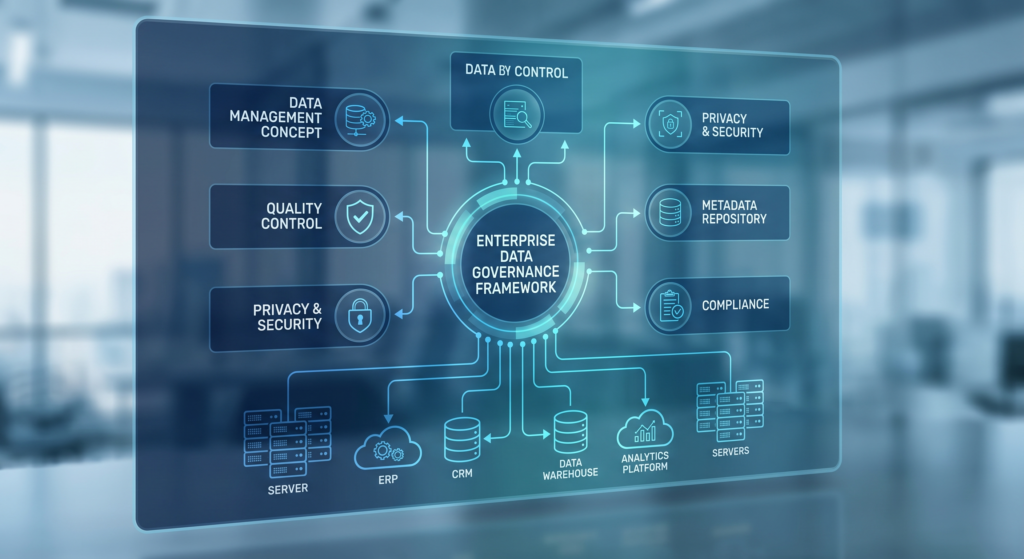
Data governance has moved from a compliance checkbox to a strategic competitive advantage. As enterprises accumulate more data from more sources, the ability to trust, find, and use that data reliably determines how effectively the organization can act on it. Poor data governance costs enterprises an estimated $12.9 million annually in data quality issues alone — and that figure doesn’t account for regulatory penalties, missed opportunities from unreliable analytics, or the compounding costs of duplicate and siloed data stores. A well-designed data governance framework eliminates these costs while unlocking the full value of your data assets.
What Data Governance Actually Means
Data governance is the system of decision rights and accountabilities for information-related processes — who can do what with which data, under what circumstances, and using which methods. It’s not a software product, a one-time project, or a purely technical discipline. It’s an organizational capability that requires clear ownership, defined processes, and sustained executive commitment to maintain.
The Four Pillars of Enterprise Data Governance
- Data Quality: Accuracy, completeness, consistency, and timeliness of data across systems
- Data Stewardship: Defined human ownership and accountability for data domains
- Metadata Management: Cataloguing what data exists, where it lives, and what it means
- Data Security and Privacy: Access controls, classification, and compliance with regulations like GDPR and CCPA
Designing Your Data Governance Structure
Governance structures range from centralized (a single CDO-led team owns all data decisions) to federated (business units own their domains with central standards) to hybrid models. Most large enterprises benefit from a hybrid approach: central standards and tooling, business-unit stewardship of domain-specific data.
Data Governance Council
A Data Governance Council — typically comprising the CDO, business unit data stewards, legal/compliance, IT, and analytics leadership — provides the executive sponsorship and cross-functional decision-making authority that a data governance program requires to drive real organizational change. Without this council, governance initiatives tend to die in committee or stall when competing priorities emerge.
Data Stewards: The Operational Core
Data stewards are the operational owners of specific data domains — customer data, financial data, product data, operational data. Their responsibilities include defining data standards, resolving data quality issues, approving access requests, and maintaining the business glossary definitions for their domain. Stewards are typically senior business users, not IT staff — because governance questions are fundamentally about meaning and business rules, not just technical implementation.
Building the Data Catalog
A data catalog is the foundational infrastructure of mature data governance — a centralized inventory of all data assets, their definitions, lineage, quality metrics, and access policies. Modern enterprise data catalogs (Alation, Collibra, Databricks Unity Catalog, Microsoft Purview) combine automated metadata collection with human-curated business context.
Business Glossary: The Source of Truth for Definitions
One of the most persistently undervalued governance investments is a business glossary — a managed list of canonical definitions for key business terms. “Revenue,” “customer,” “active user,” “churn” — these terms mean different things in different departments, and that definitional ambiguity creates endless reconciliation work in reporting and analytics. A governed business glossary eliminates this by creating a single authoritative definition that analytics teams can reference.
Data Classification and Access Control
| Classification Level | Description | Access Policy | Examples |
|---|---|---|---|
| Public | No sensitivity, safe for broad distribution | Open access | Marketing materials, press releases |
| Internal | For employee use, not for external distribution | All employees | Operational reports, internal documentation |
| Confidential | Sensitive business information, limited distribution | Role-based, need-to-know | Financial forecasts, strategic plans |
| Restricted | Highest sensitivity, regulatory implications | Explicit approval required | PII, health data, payment data |
Data Quality Management
Data quality is the most operationally impactful element of governance for analytics and AI teams. The six dimensions of data quality are accuracy (does the data correctly represent reality?), completeness (is all expected data present?), consistency (does data agree across systems?), timeliness (is the data current enough for its use case?), validity (does the data conform to defined rules?), and uniqueness (are there duplicate records?).
Implementing Data Quality Rules
Data quality rules should be implemented at both ingestion time (prevent bad data entering systems) and at rest (monitor existing data against quality standards). Tools like dbt (data build tool) allow data engineers to implement data tests that run automatically and alert stewards when quality thresholds are breached.
Regulatory Compliance Integration
GDPR, CCPA, HIPAA, and SOC 2 compliance requirements are most efficiently addressed through governance infrastructure rather than point-in-time compliance projects. When data is classified, lineaged, and access-controlled through governance processes, generating compliance evidence becomes a reporting task rather than an emergency investigation.
FAQ
- What is the difference between data governance and data management?
- Data governance defines the rules, policies, and accountability structures for data. Data management is the operational practice of implementing those rules — databases, pipelines, storage systems, and the people who run them.
- How long does a data governance program take to implement?
- A basic framework (governance council, initial stewardship assignments, data catalog for priority domains) can be established in 3–6 months. Mature, organization-wide governance typically takes 2–3 years of sustained effort.
- Do small enterprises need data governance?
- Any organization that depends on data for decisions or handles regulated personal data needs some form of governance. The appropriate scale and formality varies by size — a 50-person company needs simpler structures than a 5,000-person enterprise.
- What is a data lineage and why does it matter?
- Data lineage traces the origin, transformation, and movement of data from source systems to downstream consumers. It’s essential for debugging data quality issues, understanding the impact of upstream changes, and demonstrating regulatory compliance.
- Which is the best enterprise data catalog tool?
- For large enterprises: Collibra or Alation. For cloud-native data stacks: Databricks Unity Catalog or Microsoft Purview. For dbt-centric data teams: dbt’s built-in documentation layer with a catalog tool overlay.
Conclusion
Enterprise data governance is ultimately an organizational capability, not a technology implementation. The companies that get the most value from their data are the ones that have invested in clear ownership, consistent definitions, quality monitoring, and access controls that make data trustworthy at scale. Start with the foundational elements — a governance council, initial stewardship assignments for critical data domains, and a business glossary — and build incrementally from there. The goal isn’t perfect governance; it’s continuously improving data trustworthiness and accessibility across the enterprise.