

If you’re preparing immigration paperwork, this question comes up almost immediately:
Can I translate my own birth certificate for USCIS if I speak both languages fluently?
It sounds reasonable. It would save time and money. And many applicants assume it should be allowed.
Unfortunately, USCIS does not accept self-translated birth certificates – even if you are fully bilingual.
In this guide, we’ll explain:
- Why USCIS prohibits self-translation
- Who can translate your birth certificate
- What the certification must include
- Common mistakes that cause delays or RFEs
- Whether notarization is required
So you can submit your documents correctly the first time.
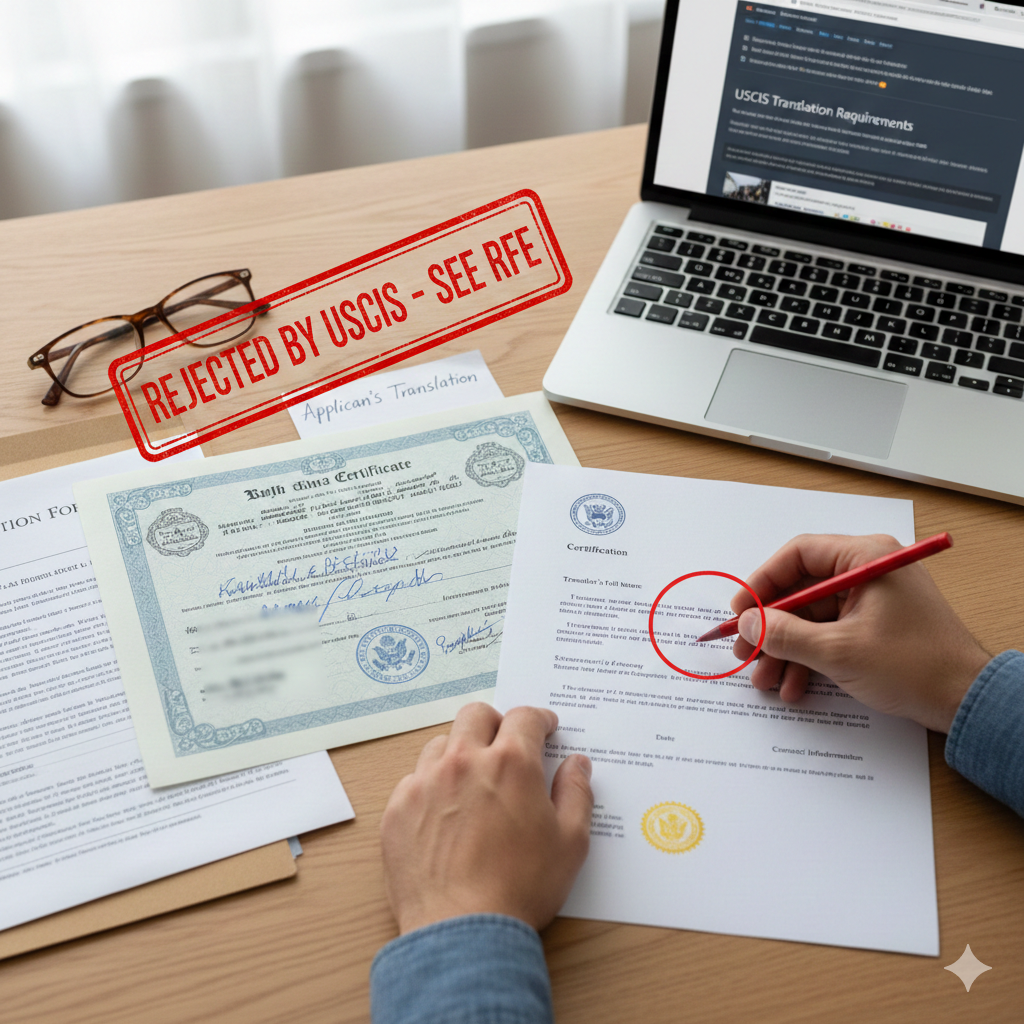
Short Answer: No, USCIS Does Not Allow Self-Translation
USCIS requires that all foreign-language documents be accompanied by:
- A full and accurate English translation, and
- A certification from a qualified third-party translator
Because you are the applicant, you cannot certify your own translation. Even perfect language skills do not override this rule.
This policy exists to protect the integrity of immigration filings and applies to:
- Birth certificates
- Marriage certificates
- Police records
- Diplomas and transcripts
- Any supporting document not in English
Why USCIS Does Not Allow You to Translate Your Own Documents
USCIS’s position is strict, and for good reason.
1. Conflict of Interest
As the applicant, you have a direct stake in the outcome of the case. USCIS requires an independent party who can objectively certify accuracy.
2. Risk of Unintentional Errors
Even fluent speakers commonly make mistakes with:
- Legal wording
- Government formatting
- Dates, seals, and registration lines
Small errors can trigger a Request for Evidence (RFE) or delay processing.
3. Fraud Prevention
A third-party certification provides accountability. USCIS must be able to identify and contact the translator if questions arise.
4. Consistency Across Applications
USCIS processes millions of cases. Standardized translation requirements ensure fair and uniform review.
USCIS policy states that any foreign-language document must be accompanied by a complete, accurate translation certified by the translator as competent in both languages.
What a USCIS-Certified Translation Must Include
Every translated birth certificate must come with a certification statement. Without it, the document is considered incomplete.
The certification must include:
- Translator’s full name
- Statement confirming the translation is accurate and complete
- Statement confirming the translator is competent in both languages
- Translator’s signature
- Date of certification
- Contact information
Missing even one of these elements can result in rejection or an RFE.
Can a Friend or Family Member Translate My Birth Certificate?
Technically, yes – USCIS does not explicitly ban friends or relatives from translating.
However, this approach carries risks.
Why Friend/Family Translations Often Cause Problems
- Perceived bias can reduce credibility
- Lack of experience with immigration formatting
- Missing certification language
- Incorrect transliteration of names
- Inconsistent spellings across documents
In practice, many RFEs stem from non-professional translations, even when done with good intentions.
That’s why most applicants choose a professional service – to avoid delays, stress, and resubmissions.
Who Is Considered a “Qualified Translator” by USCIS?
USCIS does not require a government-issued license or sworn translator status.
A qualified translator must:
- Be fluent in English and the source language
- Be independent from the applicant
- Provide a proper certification statement
Acceptable translators include:
- Professional translation companies
- Certified or experienced translators
- Independent bilingual professionals (not the applicant)
Competence and certification matter more than formal titles.
Why Self-Translation Often Leads to Rejection (Common Mistakes)
Applicants who translate their own documents often make avoidable errors, such as:
- Using non-U.S. date formats (DD/MM/YYYY instead of MM/DD/YYYY)
- Omitting seals, stamps, or registry notes
- Failing to mark unclear or illegible text
- Inconsistent spelling of names across documents
- Incorrect transliteration from non-Latin alphabets
These issues may seem minor – but USCIS treats them seriously. Once an RFE is issued, your case slows down significantly.
Does a Translated Birth Certificate Need to Be Notarized?
No. USCIS does not require notarization. A properly worded certification from the translator is sufficient. Notarization is only required if:
- Another institution (school, employer, foreign authority) specifically asks for it
If notarization is needed, it applies to the translator’s certification, not the original birth certificate.
Why Using a Professional Translation Service Is the Safer Choice
Professional translation services exist for one reason: compliance.
A reliable service ensures:
- Correct formatting
- Proper certification language
- Accurate transliteration
- USCIS-ready documents
- Faster processing with fewer risks
For most applicants, the cost of professional translation is far lower than the cost of delays, RFEs, or re-filing.
Conclusion
You cannot translate your own birth certificate for USCIS.
Even if you’re bilingual, self-translation does not meet USCIS requirements.
To avoid delays and unnecessary stress:
- Use a qualified third-party translator
- Ensure the certification is complete
- Submit documents that are accurate and properly formatted
Getting the translation right the first time helps your application move forward smoothly – and gives you peace of mind during an already demanding process.
Frequently Asked Questions
Can I translate my own birth certificate for USCIS?
No. USCIS does not accept self-translated documents.
Will USCIS reject my application if I self-translate?
It may result in an RFE or rejection until a compliant translation is submitted.
Can a bilingual friend certify a translation?
They can, but it increases the risk of errors and delays.
What makes a translator “qualified” for USCIS?
Fluency, independence from the applicant, and a proper certification statement.
Does USCIS accept scanned copies of certified translations?
Yes, scanned copies are generally accepted unless originals are specifically requested.