
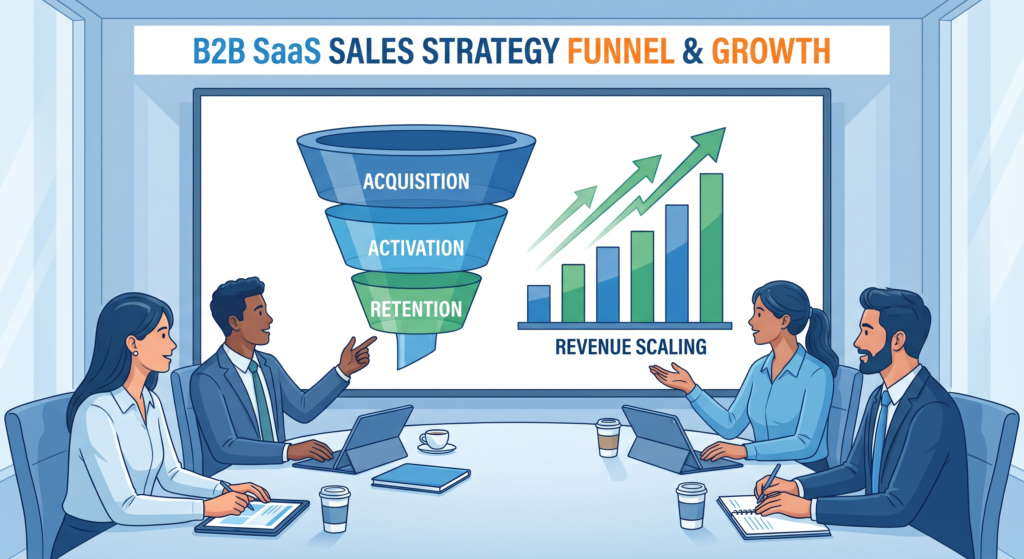
Building a B2B SaaS sales strategy that scales is one of the hardest operational challenges in tech. Early-stage growth often comes from founder-led sales, warm networks, and a handful of enthusiastic early adopters. But replicating that success through a repeatable, scalable process is a different problem entirely — one that requires deliberate design at every layer: market segmentation, sales motion, team structure, tooling, and metrics. In 2026, with longer buyer cycles, AI-native competitors, and a more discerning enterprise buyer, getting this right matters more than ever. This guide breaks down every component of a scalable B2B SaaS sales strategy, grounded in what’s actually working for high-growth teams today.
Define Your Ideal Customer Profile With Precision
Every scalable sales strategy starts with a tightly defined Ideal Customer Profile (ICP). Without it, your reps spend energy chasing deals that will never close, and the ones that do close churn faster because they weren’t the right fit. ICP definition isn’t a one-time exercise — it’s a living document that sharpens as you accumulate customer data.
Firmographic Signals That Actually Predict Conversion
Start with your closed-won data. Analyze company size (headcount and revenue), industry vertical, geography, tech stack, funding stage, and growth trajectory for your best customers — those who convert fastest, expand most, and churn least. Layer in negative ICP signals from your churned cohort. The intersection of high LTV and low CAC is your ICP sweet spot. Most SaaS teams find their true ICP is 40–60% narrower than their initial assumptions.
Buying Committee Mapping
In enterprise B2B SaaS, deals are rarely won by convincing a single buyer. Map the full buying committee for your ICP: the economic buyer (holds budget), the champion (internal advocate), technical evaluators (IT, security, compliance), and end users. Each persona has different concerns, different content needs, and different definitions of value. Your sales strategy must account for all of them.
Intent Data and Trigger Events
Modern ICP definitions extend beyond static firmographics to include behavioral signals. Funding announcements, leadership changes, new product launches, competitive migrations, and hiring spikes in relevant roles are all trigger events that correlate with buying intent. Tools like G2, Bombora, and 6sense surface these signals at scale, letting your team prioritize accounts that are actively in-market.
Choose the Right Sales Motion for Your Market Segment
Your sales motion — how you acquire, qualify, and close customers — should be matched to your ACV, deal complexity, and buyer sophistication. Running the wrong motion is one of the most common and expensive mistakes in B2B SaaS.
Product-Led Growth (PLG) as a Sales Accelerator
PLG doesn’t mean “no sales team.” For SaaS products with a natural self-serve adoption path (developer tools, productivity software, collaboration platforms), PLG creates a pipeline of highly qualified, product-engaged leads for sales to convert to paid or expanded contracts. The PLG + sales-assist hybrid — sometimes called “product-led sales” or PLS — is one of the highest-performing motions in 2026 for SMB and mid-market segments, combining low acquisition cost with sales leverage at key conversion points.
Enterprise Sales Motion: When to Use It
For deals with ACV above $50K, complex security and procurement requirements, or multi-stakeholder buying committees, a dedicated enterprise sales motion is required. This means named account strategy, multi-threaded relationship development, formal RFP/POC processes, and sales cycles measured in months rather than days. Enterprise motion requires experienced AEs, strong sales engineering support, and a patient approach to pipeline development.
Velocity vs. Value: Matching Motion to Segment
Many SaaS companies run multiple motions simultaneously — a high-velocity, low-touch motion for SMB and a high-touch enterprise motion for strategic accounts. The key is clear segmentation by ACV and deal complexity, with dedicated teams, compensation structures, and processes for each. Blurring the lines — sending enterprise AEs after $5K deals, or routing six-figure opportunities through a self-serve funnel — is a reliable path to underperformance in both segments.
Build a Repeatable Pipeline Generation Engine
Consistent pipeline is the lifeblood of a scalable SaaS sales org. The mistake most teams make is treating pipeline generation as a variable activity rather than an engineered system with measurable inputs and outputs.
Outbound: Quality Over Volume in 2026
The spray-and-pray era of outbound is over. Enterprise buyers receive hundreds of cold touches per week, and generic outreach is filtered immediately — by spam algorithms and by humans. The teams winning with outbound in 2026 are running highly personalized, account-centric sequences: researching each account’s specific business context, referencing trigger events, and leading with relevant insight rather than product pitches. AI tools now assist with research and personalization at scale, but the strategic layer — which accounts to prioritize and what angle to lead with — still requires human judgment.
Inbound: Content That Attracts ICP Buyers
High-quality inbound is a compound asset — it appreciates over time as content ranks, earns backlinks, and builds brand authority. For B2B SaaS, the content that drives qualified inbound tends to be highly specific: comparison pages, integration use-case content, ROI calculators, industry-specific use cases, and deep-dive guides that address the exact questions your ICP has during evaluation. Map content to buying journey stages and measure by pipeline influenced, not just traffic.
Partner and Ecosystem-Led Pipeline
For enterprise SaaS with established integration ecosystems, partner-sourced pipeline can scale significantly without linear headcount growth. Technology partners, resellers, GSIs (global systems integrators), and agency partners with access to your ICP are all worth investing in. The key is building partner programs with clear ROI for the partner, not just co-marketing fluff. Joint GTM plays, deal registration systems, and partner-specific enablement drive real pipeline.
B2B SaaS Sales Strategy Framework Comparison
| Sales Motion | Typical ACV | Sales Cycle | Team Structure | Key Metrics | Best For |
|---|---|---|---|---|---|
| Self-Serve / PLG | <$5K | Days–weeks | Growth, CS | PQL rate, activation, expansion MRR | Developer tools, SMB |
| Transactional Inside Sales | $5K–$25K | 1–4 weeks | SDRs + AEs | Lead velocity, win rate, ramp time | Mid-market, horizontal SaaS |
| Mid-Market Sales | $25K–$100K | 1–3 months | AEs + SEs + CS | Pipeline coverage, ACV, NRR | Vertical SaaS, mid-size accounts |
| Enterprise Sales | $100K+ | 3–12 months | ENT AEs + SEs + CSMs + Legal | ARR, deal velocity, multi-year TCV | Complex enterprise platforms |
Structure, Hire, and Enable a Scalable Sales Team
Hiring great salespeople into a broken system produces mediocre results. Structure and enablement must come before headcount growth.
Sales Team Structure and Ratios
The most common enterprise SaaS team structure pairs SDRs (pipeline generation) with AEs (pipeline execution), supported by Sales Engineers (technical validation) and Customer Success Managers (retention and expansion). Common ratios are 1 SDR per 2–3 AEs for outbound-heavy motions, and 1 SE per 3–5 AEs for complex technical sales. First-line sales managers typically carry a span of 6–8 reps. Getting these ratios wrong — particularly under-resourcing SE and CS — is a common cause of poor win rates and high churn.
Defining Ramp and Quota Correctly
New AE ramp periods of 3–6 months are standard; enterprise AE ramps can extend to 9 months given longer deal cycles. Quota should be set at 4–6x OTE for sustainable models — below 4x and the math doesn’t work for the business, above 6x and you either have quota achievement problems or you’re leaving comp on the table. Review quota attainment distribution quarterly: if fewer than 60% of reps are hitting quota, the problem is quota design or enabling, not rep performance.
Sales Enablement as a Growth Lever
Enablement is not training for its own sake. Effective enablement is tightly connected to pipeline metrics: it identifies the specific gaps in the funnel (why are we losing at technical validation? why are champions not getting executive buy-in?) and closes them with targeted tools — battlecards, ROI calculators, objection-handling guides, and customer proof points organized by persona and industry. Platforms like Highspot, Seismic, or Guru are worth investing in once you have more than 20 quota-carrying reps.
Build Forecasting and Revenue Operations That Scale
A sales strategy without rigorous measurement is guesswork. Revenue operations (RevOps) is the function that ties strategy to execution through clean data, consistent process, and reliable forecasting.
Pipeline Metrics Every SaaS Sales Leader Should Track
The core pipeline metrics are: pipeline coverage ratio (target 3–4x quota in qualified pipeline), stage conversion rates (where deals stall or die), average deal size and velocity, and lead-to-opportunity conversion rate by source. Layer in cohort-based win rate analysis by segment, industry, and competitor to understand where your strategy is strongest and where it needs shoring up.
Forecasting Methodologies That Work
Roll-up forecasting (bottom-up from rep to manager to VP) provides ground truth but is susceptible to sandbagging. AI-assisted forecasting — using engagement signals, historical patterns, and deal risk factors rather than rep sentiment — improves accuracy significantly. Leading CRM platforms and dedicated tools like Clari and Gong Forecast now provide statistically grounded forecast models that outperform pure roll-up methods for most enterprise teams.
Net Revenue Retention: The Metric That Defines SaaS Health
In SaaS, the initial sale is just the beginning. Net Revenue Retention (NRR) — the percentage of recurring revenue retained from existing customers including expansions and contractions — is the single most important indicator of long-term business health. World-class SaaS NRR runs 120–140%+, meaning expansion revenue from existing customers more than offsets churn. Your sales strategy must include deliberate expansion motions (upsell, cross-sell, tier upgrades) built into the customer lifecycle, not just reactive renewal conversations.
Frequently Asked Questions: B2B SaaS Sales Strategy
What is the biggest mistake B2B SaaS companies make in their sales strategy?
The most common mistake is hiring sales headcount before achieving a repeatable sales process. Adding reps to a process that isn’t validated yet just scales the dysfunction. Nail a repeatable playbook with a small, high-quality team first — then hire to scale it.
How do you build a sales process for a new B2B SaaS product with no customer data?
Start with founder-led sales. The founder (or a sales leader in close partnership with the product team) should run the first 20–50 deals personally, taking detailed notes on buyer objections, decision criteria, and champion characteristics. This qualitative data, combined with early win/loss analysis, forms the foundation of your ICP and sales playbook.
When should a B2B SaaS company hire its first sales rep?
The conventional wisdom is to hire your first sales rep only after the founders have closed at least 5–10 deals themselves and can articulate a repeatable reason for why customers buy. Hiring too early — before product-market fit or a clear ICP — results in high rep turnover and wasted CAC.
How important is outbound in 2026 compared to inbound?
Both matter, but their relative importance depends on your market and motion. For enterprise deals in specific verticals, outbound remains essential for reaching key accounts that don’t come to you organically. For horizontal SaaS with broad ICP, inbound-led with SDR qualification tends to be more efficient. The best strategies run both with clear attribution and budget allocation based on CAC payback by channel.
What does a good B2B SaaS sales compensation plan look like?
A standard structure is 50/50 base/variable split, with the variable portion paid against quota attainment — typically a straight-line or accelerated commission rate. Accelerators above 100% quota attainment (e.g., 1.5x commission rate for 100–120%, 2x above 120%) drive outsized performance. For enterprise roles, multi-year TCV components and expansion incentives improve alignment with business outcomes.
How do you reduce churn in B2B SaaS?
Churn reduction starts in sales — qualifying rigorously for ICP fit and setting accurate expectations during the sales process. Post-sale, structured onboarding, regular business reviews, and early warning systems (based on product usage signals and relationship health scores) are the primary levers. Customer Success and Sales must be tightly aligned on handoff, with shared NRR accountability.
What role does AI play in B2B SaaS sales in 2026?
AI is accelerating several functions: account research and ICP matching (faster, richer than manual research), personalized outreach at scale, conversation intelligence (call analysis, coaching recommendations), pipeline forecasting, and renewal risk detection. The reps who use AI as a force-multiplier for high-judgment tasks — prioritization, deal strategy, relationship development — are significantly outperforming those who don’t.
Conclusion
A scalable B2B SaaS sales strategy isn’t built overnight, and it isn’t built by copying someone else’s playbook exactly. It’s assembled layer by layer: a precise ICP, a sales motion matched to your deal complexity, a pipeline engine with diversified sources, a structured team with real enablement, and a RevOps function that makes the whole system visible and improvable. In 2026, the teams pulling ahead are the ones who treat sales as a system — not a collection of individual performers — and invest in the infrastructure that makes every rep more effective. Build the system first. The growth follows.
—