
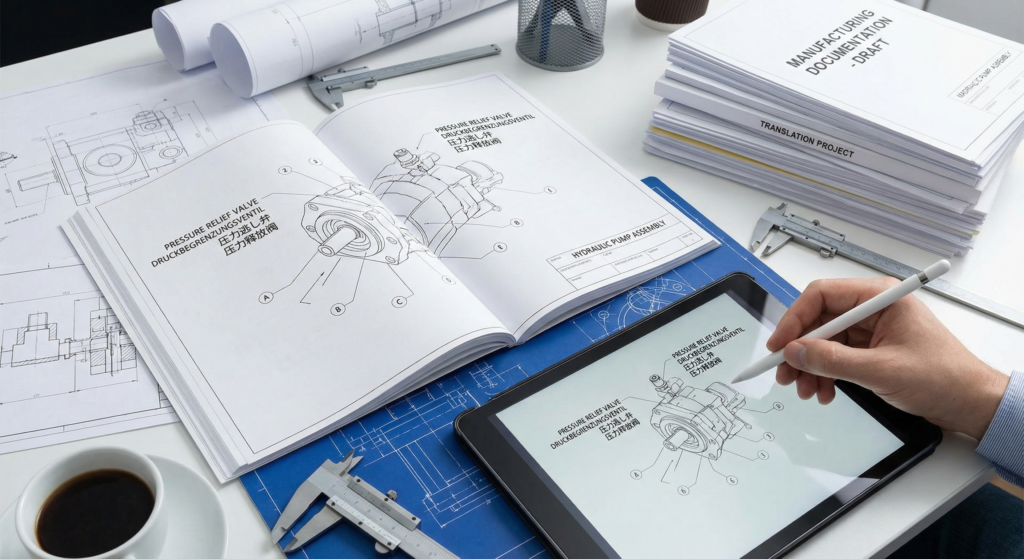
Technical documentation exists to enable precise, safe, and effective use of complex systems. When that documentation crosses a language barrier, the stakes couldn’t be higher. A mistranslated safety instruction in a manufacturing manual can cause workplace injuries. An error in software documentation can lead to system failures. An inaccurate engineering specification can compromise a product’s structural integrity.
Technical document translation is one of the most demanding disciplines in the language services industry — and one of the most consequential. This guide covers best practices for organizations in engineering, IT, and manufacturing who need their technical content translated without sacrificing accuracy, consistency, or usability.
What Makes Technical Translation Different
Standard translation requires linguistic skill. Technical translation requires that plus deep subject matter expertise. A translator working on an injection molding manual needs to understand injection molding. One translating API documentation needs to understand software development. Without that contextual knowledge, even accurate word-for-word translation produces content that is confusing, incomplete, or dangerously wrong.
Key Challenges in Technical Document Translation
- Specialized terminology: Technical fields have precise vocabularies that must be translated consistently across all documents
- Regulatory compliance: Many technical documents must meet country-specific regulatory standards (CE marking, FDA compliance, ISO standards)
- High volume with frequent updates: Technical documentation changes constantly as products evolve
- Complex formatting: Tables, diagrams, CAD annotations, and structured authoring (DITA, XML) add technical complexity to the translation workflow
- Cross-document consistency: The same term must be translated identically across hundreds of documents
Best Practices for Engineering Document Translation
1. Build and Maintain a Termbase
A termbase (terminology database) is the single most important investment in a technical translation program. It defines approved translations for every key technical term in every target language. Without a termbase, different translators will translate the same term differently, creating inconsistencies that confuse users and undermine trust in your documentation.
Your termbase should be built collaboratively with subject matter experts from your engineering teams and native-speaking technical translators for each language. It should be stored in a dedicated terminology management system (such as SDL MultiTerm or MadCap Lingo) and provided to all translators working on your content.
2. Use Translation Memory Strategically
Technical documentation contains enormous amounts of repeated and similar content. Warnings, safety notices, standard procedures, and boilerplate text appear across hundreds of documents. Translation Memory (TM) technology stores every translated segment and automatically applies it when the same or similar text appears again.
For technical content, TM leverage rates of 40–70% are common on repeat projects — meaning nearly half to two-thirds of content doesn’t need to be retranslated, dramatically reducing cost and turnaround time while improving consistency.
3. Choose Translators with Verified Technical Backgrounds
For engineering and manufacturing content, prefer translators who have formal education or industry experience in the relevant technical field. A mechanical engineer who is also a certified translator brings both linguistic and technical authority to the work. This combination is less common and more expensive, but essential for safety-critical documentation.
Best Practices for IT and Software Documentation
4. Integrate Translation into Your Development Workflow
For software documentation and UI strings, manual file handling creates bottlenecks and version control nightmares. Modern translation management systems (TMS) integrate directly with GitHub, Confluence, Jira, and major CMS platforms. When documentation is updated, changes are automatically flagged for translation, reducing manual effort and keeping localized content in sync with source updates.
5. Write for Translatability from the Start
The easiest way to improve technical translation quality is to improve source content quality. This practice — known as Controlled Authoring or Simplified Technical English (STE) — involves writing source content according to rules that make it easier and cheaper to translate accurately:
- Use short, direct sentences (max 20–25 words)
- Avoid idioms, metaphors, and humor
- Use active voice consistently
- Define one meaning per term and use it consistently
- Avoid ambiguous pronouns
Technical Translation Quality Framework
| Document Type | Risk Level | Recommended QA Process | Reviewer Profile |
|---|---|---|---|
| Safety manuals & warnings | Critical | TEP + back-translation + SME review | Technical expert + in-country reviewer |
| Installation & operation manuals | High | TEP + in-country review | Technical translator + end-user rep |
| API & developer documentation | High | TEP + developer review | Technical translator with coding background |
| Training materials | Medium | Translation + editing | Subject matter translator |
| Internal technical specs | Medium | Translation + light edit | Technical translator |
| Marketing collateral (technical) | Lower | Translation + proofreading | General technical translator |
Best Practices for Manufacturing Documentation
6. Address Regulatory and Compliance Requirements Early
Manufacturing documentation often must comply with country-specific regulations. In the European Union, CE marking requires technical documentation — including instructions for use — in the official language(s) of each member state where the product is sold. In the US, OSHA mandates that safety information be accessible in the languages spoken by employees.
Build regulatory requirements into your translation planning. Identify which markets require certified translations (stamped and signed by a certified translator), which require notarized translations, and which have specific formatting or content requirements.
7. Manage Diagrams, Tables, and Graphics Effectively
Technical documents are rarely text-only. CAD diagrams, exploded assembly views, schematics, and infographics all contain translatable text — labels, callouts, annotations. Processing these elements requires either editing source files (in CAD, InDesign, Visio, etc.) or using text overlays.
Work with agencies that have desktop publishing (DTP) capabilities and can handle your source file formats. Agencies without DTP support will return translated documents with untranslated graphics — a common failure mode in technical translation projects.
8. Plan for Ongoing Updates, Not One-Time Projects
Technical documentation is never “done.” Products evolve, regulations change, and user feedback generates documentation revisions. Structure your translation program to handle ongoing updates efficiently — using TM to avoid re-translating unchanged content, version control to track document history, and streamlined review processes for incremental changes.
FAQ
Q: What qualifications should I look for in a technical translator?
A: Look for translators with a combination of language qualifications (ATA certification or equivalent) and technical credentials (degree or professional experience in the relevant field). For safety-critical documents, prefer translators who are native speakers of the target language with verified engineering or technical backgrounds.
Q: How much does technical document translation cost?
A: Technical translation typically costs $0.15–$0.35 per source word, higher than general translation due to the expertise required. Safety-critical content requiring back-translation and SME review will be at the higher end. TM leverage can significantly reduce costs on ongoing projects.
Q: Can machine translation be used for technical documents?
A: Machine translation with professional post-editing (MTPE) is increasingly used for technical content where speed and volume are priorities. It works best for highly repetitive content with clear, simple language. For safety-critical instructions, MTPE should always include thorough human review by a subject matter expert.
Q: What is back-translation and when is it necessary?
A: Back-translation involves translating a document back into the source language (by a different translator) to verify accuracy. It’s most commonly required for clinical trial documentation, pharmaceutical labeling, and other regulated content where errors could cause harm. It adds cost and time but is essential for certain high-risk documents.
Q: How do we maintain terminology consistency across large documentation sets?
A: The answer is a well-maintained termbase combined with Translation Memory. Both tools should be part of your vendor relationship from day one. Require your translation agency to build and maintain a client-specific termbase, and ensure you own and can export that asset if you ever change providers.
Conclusion
Technical document translation done right is an investment in user safety, regulatory compliance, and market success. Done poorly, it creates liability risks, erodes user trust, and can cost far more to remediate than a quality program would have cost upfront.
The organizations that get technical translation right treat it as a discipline, not a task. They invest in terminology infrastructure, choose linguists with genuine technical expertise, build translation into their product development workflows, and maintain long-term partnerships with agencies that know their products and industries.
If your organization is expanding into international markets with technical products or services, don’t treat translation as the last step in the process. Make it a strategic priority from the start.